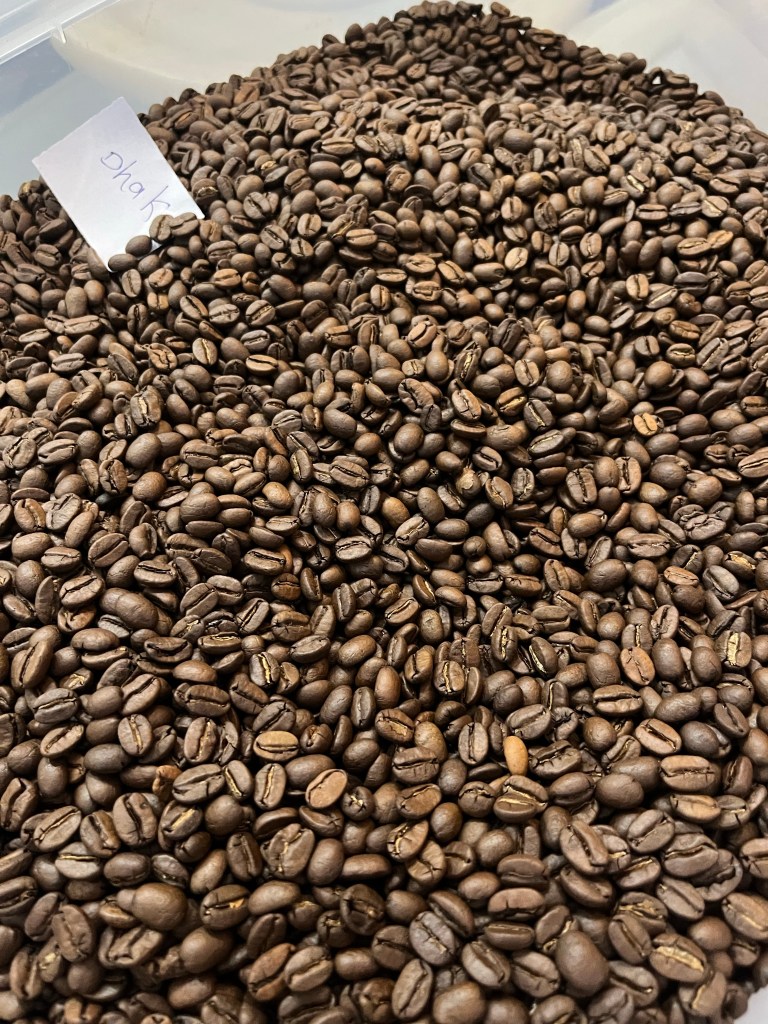
Having been a home brewer for years, and enjoying a good cup of coffee daily!
The Roastery tour was fascinating.
The effort, that goes into the brew of a single cup of coffee is huge, and within a few sips/Slurps, we have our verdict of liking or disliking the coffee.
The tour began with all those interested in assembling in a room and introduction of themselves, and what interested them about coffee and the tour.
We then moved to the storage room, where 1000 Kg gunny bags of green coffee beans were stored.
Each bag had a variety of green coffee beans which is sorted manually for good, bad and damaged beans.
They are then collected into a storage box before they go into roasting.
Each day 180 Kgs of green coffee beans are sorted manually at the Roastery.
There are a couple of green coffee varieties. They are Natural, Washed, Honey Processed (Red/Yellow) Malabar, and anaerobic fermentation.
Each of these beans have their own texture and size.
Natural: They are the natural ones. No Water or machines used to remove the coffee beans
Washed: They get washed away by water and then dried.
Malabar: A variety that’s popular in India. Is salt-panned coffee beans.
Honey Processed: A Process where coffee beans are de-pulped and dried without being washed. The golden sticky substance that remains is something like honey, which is why it’s known as honey processed.
Anaerobic fermentation: This is when the coffee cherries are locked into an airtight fermentation tank after being harvested, to stop any Carbon -dioxide from escaping.
The second room was the roasting room.
The green coffee beans that has to be roasted are thrown into a hopper then a roasting profile is set ,that the roasters thinks is the most appropriate for the coffee beans and then the coffee is roasted into the roaster. There are three drums within the roaster.
And the coffee once roasted is flushed out in a section and spun over a few minutes where it cools down, before it can be taken into production for the cafés brewing, for cafe retailing, for E-Commerce purchases and other outlets that source beans from the Roastery.
The packaging is done within minutes and ready to be sent all over.
The beans Preferably should be consumed within a month from the date it has been roasted to enjoy the flavour profile and taste of the coffee.
Post our Tour we also tried the coffees at the Roastery.
We brewed the pour over method and tried the drip bags too.
Oh! Please note before the Roastery brews a large batch of coffee, they have a portable roasting machine, that they use to sample beans.
The Roastery has to choose coffee from about 800 odd samples from which they choose about 40 odd samples they would produce under their Roastery.


 A K H I L N A N D A